Moonlight (2016)
This review was composed a few hours after seeing Moonlight during the spring semester of my sophomore year at college. In preparation for that year's 89th Academy Awards, I saw all 9 Best Picture nominees, with Moonlight being the first film watched. My overall rating for the film was 4 stars out of a possible 4. It was the 219th film to receive my highest rating distinction.
This film really made me think. To help put this statement into perspective, allow me to present today's post-class timeline. I watched this with one of my roommates in the early evening, went to attend an incredible 90-minute lecture about women in the Russian Revolution, had Mongolian food for dinner, played a few Sporcle quizzes, listened to Donna Lewis’ debut album Now in a Minute, and stared at the ceiling from the comfort of my bed, before finally starting this review more than four hours after I completed Moonlight. The reason for this late start is not procrastination. Rather, it is because I have had to really take in everything the picture gives me as an audience member, me as a critic, and me as an aspiring filmmaker.
This film is coming off like The French Connection (1971) and Bunny Lake Is Missing (1965): two films that do not feel like four-star films, but after closer examination they reveal themselves to wholly deserving of four stars. However, I do not know how I will rate this film, and I will not know until I finish this review – it just depends on how well I praise or question this film and how well it holds up upon recollection.
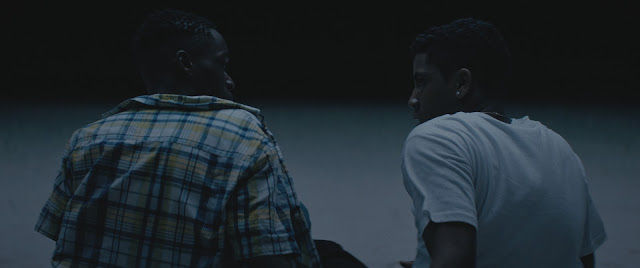
The very first observation I made of this film was the unorthodox cinematography choices. This has one of the strangest and best examples of cinematography I have ever witnessed. Unfortunately, the film editing is not up to par with the cinematography, which makes it a little difficult to watch.
I loved how this film started off. It goes towards a type of realism that you seldom see in cinema. We start on Juan (played impeccably by Mahershala Ali), pulling up in his car and exchanging pleasantries with a friend on the opposite side of the street. This confused me at first and caused me to question if I had received bad information on the film: that we first see the lead character, and then see the three important stages of his life as a flashback. Almost immediately afterwards, some kids run past Juan and the camera chooses to follow them. Once it centered on the front child following the chase, I began to wonder if he was the main character. Then, when Juan appeared soon after, I returned to my speculation that Juan was in fact the lead. It was not until the screen went dark and said “i. Little” that I finally realized the little boy was our main character. Up until that point, I had thought that Juan was helping the little boy because he reminded him of a situation Juan experienced as a young boy. And although I was confronted by constant confusion during the opening of this film, I loved it because of the realization it presents once the screen went dark. This film started off the way most of our initial involvements with others begin, by something small, possibly insignificant, sparking our curiosity and interest. It is at this moment that I recognized the uniqueness of this film and eagerly anticipated what would come next.
Something I can definitively say about Moonlight that I cannot say about too many others is there are no bad acting performances to be found. I have wondered if Chiron has the fewest words ever for a non-mute main character in a non-silent movie. I have never seen The Piano (1993), and I have heard that Holly Hunter’s character does not speak much, so I will have to wait and see how much she speaks compared to Chiron.
The direction here is good, but not quite as powerful and effective as a movie this contemplative, this successful at making an equally simplistic and complex plot, should be. This film shocked me in the subtlety and directness it took in combating its very sensitive, occasionally adult material. An example of this is when Chiron, then known by the moniker “Little,” asked Juan and Teresa what a particular word (that I refuse to type here) meant and then asked whether he was that word. What shook me about this scene is not the out of the blue nature of Little bringing it up, although that really did catch me off guard, but the glances between Juan and Teresa as they silently decided how to respond to the little boy’s inquiries.
I enjoyed the three distinct types of soundtrack this film utilized: classical music for some scenes, modern music with lyrics that matched the mood/atmosphere/characters (and their self-imposed personas), and ambience when the situation was just right. I am so pleased that they employed these three types expertly instead of just relying on one of them to do the heavy lifting.
And lastly, the ending, which is ambiguous in its own unique way. Now, you know me and ambiguous endings: I simply cannot get enough of them. And the same couldn't be more true here. Chiron reveals to Kevin that he is the only man and person Chiron’s been with, we see Kevin’s facial expression changes, there is a shot of Chiron’s head on Kevin’s shoulder, and then a fade cut to Little standing in his shorts before the moonlight reflecting off the ocean. What stands out to me about this ending is how it is ambiguous. The audience knows everything that goes on in those last few moments: they know the dialogue, they know the actions, they know the reconciliation and intimate poses, they know who the little boy is in front of the ocean. They know it all… except why they see Little at the end. This stands out to me as a connoisseur of ambiguous endings because it is the ambiguous ending people will not care about simply because it does not leave them with any glaring questions unanswered. To me, that makes this ending equal parts beautiful and infuriating, which only furthers its greatness.
So, here we are. At the end of the review and the time for a star rating. After careful and meticulous deliberation, I can say with the utmost certainty that my inklings about it following suit with The French Connection and Bunny Lake Is Missing were correct. Moonlight is undoubtedly 4 stars and one of the most impressive films released this century.


Comments